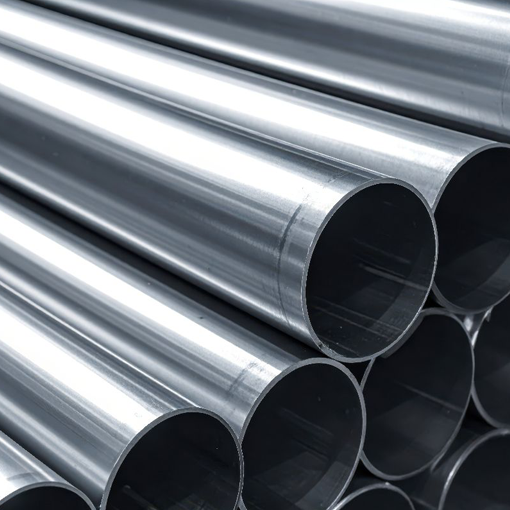
321 Stainless Steel Pipe
Manufacturing Process: Billet piercing, cold rolling, solution heat treatment.
Applicable Standards: Manufactured per Chinese national standards; technical indicators for reference to overseas specifications.
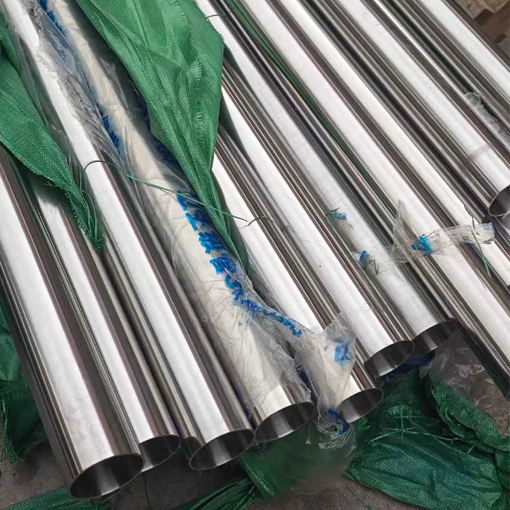
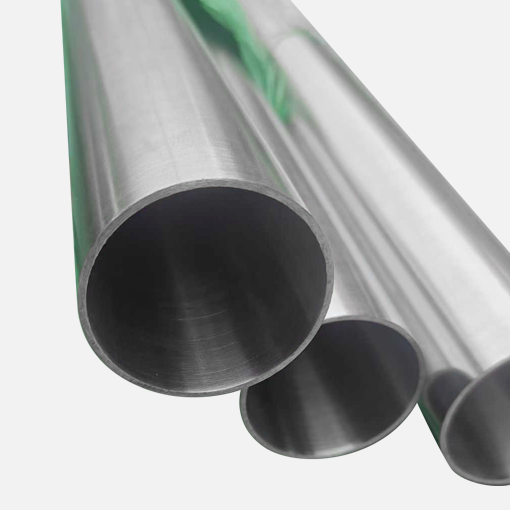
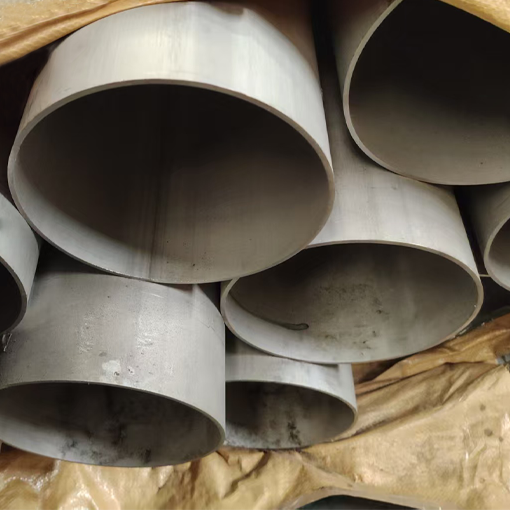
Surface Condition: Pickled dark finish or bright annealed surface.
Main Application: High‑temperature flue gas pipeline, boiler components, thermal power auxiliary piping, high‑temperature process equipment.
Key Performance Note: Titanium stabilization restrains carbide precipitation under sustained high‑temperature working conditions.
Value‑added Service: Custom cutting, pipe‑end beveling.
Export & Supply: Capped pipe ends, steel bundle packing; direct factory supply for high‑temperature energy‑related projects.
321 Stainless Steel Pipe for High-Temperature Industrial Systems — Titanium-Stabilized, Long-Term Service Ready
Standard austenitic grades fail, and sensitization is the reason. 321 Stainless Steel Pipe goes another way. Titanium gets added at a minimum ratio of 5×(C+N). Stable titanium carbides then form at the grain boundaries, not chromium carbides. Weld it, or let it sit for long hours between 427°C–816°C (800°F–1500°F), and the alloy still fights off intergranular corrosion. Most fabrication jobs do not need post-weld annealing. Tianjin Youcheng Technology Co., Ltd. stocks and distributes this grade. Roughly 200 tons sit on hand, and the standard production lead time is 7–10 days.

What Sets 321 Apart from Standard Austenitic Grades
For 304 and 304L, there are two ways to handle sensitization. Keep the carbon content low. Or anneal the part after welding. Grade 321 follows a different principle. Titanium goes in at a minimum ratio of 5×(C+N). It grabs the free carbon and holds on to it. Carbon never travels to the grain boundaries, so chromium is not stripped out during thermal exposure.
So the pipe keeps its corrosion resistance after long thermal cycling or repeated welding passes. In most cases re-annealing can be skipped. Some systems run nonstop above 400°C. Boiler flue lines are one case. Two more are thermal process equipment and heat exchangers. Under those conditions, this stabilization step gives a real reliability edge that 304-series pipe does not offer.

Chemical Composition and Key Properties
The alloy carries 17–19% chromium and 9–12% nickel. Titanium is what makes this grade different. It gets added to stabilize the metal. Yield strength tends to sit near 30,000 psi. Turn the heat up, and creep and stress rupture properties stay useful. At that point 304 and 304L begin losing dimensional stability.
Annealed pipe shows no magnetism at all. A small amount can turn up after cold working, since martensite forms. Either way, corrosion resistance does not change. Thermal performance holds steady too.
Run it in continuous service and oxidation resistance holds to 815°C (1500°F). For work that needs structural integrity at high heat, this grade fits well.

Product Specifications
| Parameter | Details |
|---|---|
| Grade | 321 titanium-stabilized stainless steel |
| Pipe Type | Seamless / Welded |
| Outer Diameter | 14 mm – 530 mm |
| Wall Thickness | 1.5 mm – 24 mm |
| Pipe Length | Random mill length or custom cut-to-length |
| Pipe End | Plain end / Beveled end |
| Surface Condition | Pickled dark finish or bright annealed |
| Heat Treatment | Solution annealing |
| Chemical Composition | Cr: 17–19%, Ni: 9–12%, Ti: ≥5×(C+N) |
| Yield Strength | Typical 30,000 psi |
| Max Service Temp. | 815°C (1500°F) continuous oxidation resistance |
| Documentation | Mill Test Certificate (MTC) per EN 10204-3.1 layout |
| NDT | Standard NDT included; third-party inspection available |
| Standards Reference | ASTM A312, A213, A269 |
Key Product Features
- Carbide precipitation stays under control when the titanium stabilization ratio is ≥5×(C+N). That ratio also helps the pipe fight intergranular corrosion at high temperatures
- Two forms are available to order. Seamless pipe is one, welded pipe is the other. Their pressure ratings are not the same. Neither is the way each one gets fabricated. Every form suits a different job
- Oxidation resistance holds up to 815°C (1500°F). That applies to continuous service
- Full batch traceability from mill to delivery
- Custom cut-to-length sizes are available on request. So is pipe-end beveling
- MTC documentation per EN 10204-3.1 layout included with each order

Quality Control
Nothing ships before it gets inspected. The steps themselves stay the same. Positive Material Identification (PMI) is one of them. Crews check the titanium-to-carbon ratio. That reading proves the grade is real. Intergranular corrosion testing runs to ASTM A262 Practice E. As that test shows, the titanium stabilization holds across the full pipe wall.
Hydrostatic testing is how pressure integrity gets checked. For flaws buried below the surface, you need something else: Ultrasonic Testing (UT) or Eddy Current testing. Grain size is measured per ASTM E112. That figure tells you if the steel in 321 Stainless Steel Pipe can handle creep in high-temperature service.
The MTC paperwork comes in the EN 10204-3.1 format. Does your project specification call for third-party inspection? We can arrange that. It costs extra.

Application Areas
Power Generation: Flue gas pipelines run hot, and they stay hot. Boiler tubes face the same grind. Furnace components and expansion joints work under that pressure too. Nothing cools down for long. So the metal has to keep its shape for years on end.
Chemical and Refining: Take thermal oxidizers. Add refinery heaters, plus high-temperature chemical process equipment. In all of these, sensitization of 304-series pipe is a problem people have written down.
Industrial Heat Processing: Heat exchangers fall in this group. So do recuperators, along with thermal process lines. These parts keep cycling through the carbide precipitation temperature range, over and over. Corrosion resistance still has to hold up. And the line cannot be shut down for repairs all the time.

Packaging and Delivery of 321 Stainless Steel Pipe
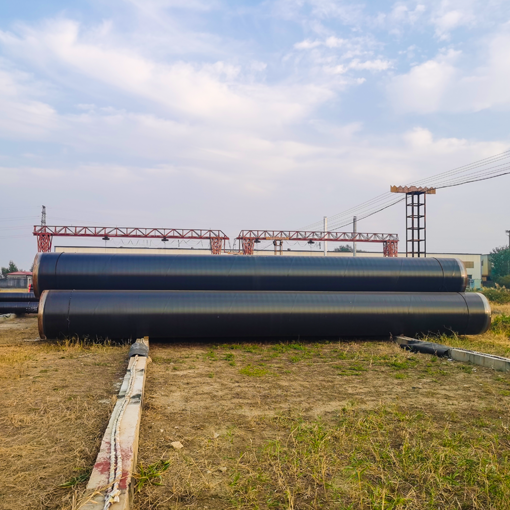
Before shipping, we cap each pipe end. This protects the surfaces while the goods are in transit. Steel strapping holds the bundles tight, which makes handling and stacking safe.
Our freight forwarding partners have been in the business for years. They handle sea and land freight to Europe, the Middle East, South America, and Africa. About 200 tons of stock is ready for orders that need fast delivery. Normal production lead time is 7–10 days.
Add any specific delivery requirements or project timelines to your inquiry. We will check what is available for 321 Stainless Steel Pipe and send the lead time back to you.

FAQ
Q: Does this product weld without much trouble?
A: Yes. Welding it works fine. For filler metal, pick E347 or E321. That way the stabilization benefits hold up in the weld zone.
Q: How does 321 differ from 304L?
A: The carbon level in 304L is lower. That slows sensitization down. Grade 321 goes a different way. Titanium catches the carbon before it can react at the grain boundaries. Above 427°C (800°F), this is what keeps 321 going longer when service runs for years.
Q: Does a magnet stick to this product?
A: In the annealed state, a magnet will not stick to the metal. Cold working can leave a little magnetism behind. Martensite is what causes it. That magnetism does not change how the metal fights corrosion. It also has no effect on how it handles heat.
Q: How hot can it be run continuously at most?
A: Oxidation resistance is at its best at 815°C (1500°F). Heat wears mechanical strength down too. So for a given job, the design has to fit the conditions it will really meet.
Q: Why choose 321 instead of 347?
A: For high temperature work, Grade 321 is usually the cheaper option and the easier one to source. Niobium stabilization is what sets Grade 347 apart. When aqueous corrosion gets harsher, that grade becomes the pick for some buyers.
Q: What paperwork comes with the pipe?
A: A Mill Test Certificate (MTC) in the EN 10204-3.1 format goes out with every order. NDT is part of the standard supply. Third-party inspection can also be set up, and it costs extra.
Contact Us
Send your specifications for 321 Stainless Steel Pipe — including grade, size, quantity, and delivery destination — to sales@youchengkjsteel.com. We will respond with availability and pricing.