How do manufacturing processes affect pipe cost and strength
The steps used to make pipes affect both their cost and their strength. This is because each step—the quality of the steel strip, the accuracy of the shaping, the control of the welding, the wall thickness, and the testing—affects both cost and performance. That is why you need to know which steps are important when you buy SSAW carbon steel pipe for a water project, a gas gathering line or a filling job. This guide breaks down each step of the process, shows where the money goes, and tells you how to figure out how strong a pipe is before you buy it.

What Shapes SSAW Carbon Steel Pipe Manufacturing from Start to Finish
What SSAW Carbon Steel Pipe Means
You can find SSAW carbon steel pipe, which stands for Spiral Submerged Arc Welded pipe. A steel strip is wound into a spiral shape, and then submerged arc welding is used on both the inside and outside of that spiral seam. The pipe has a weld line, but it doesn't run straight down the length like LSAW pipe does. This isn't a seamless process.
With spiral forming, a thin steel coil can make a lot of different outside diameters. When we run outer diameters from 219 mm to 3620 mm at Tianjin Youcheng Technology, we use the same stocks of strips. One reason SSAW is still competitive for big projects is that it can work with plates that are wider than those used by LSAW mills.
How SSAW Carbon Steel Pipe Is Made
The process follows a fixed order, and skipping steps shows up later as weld defects or dimension problems. Here is the typical sequence:
- Strip inspection and preparation. Coils get checked for thickness, surface rust, and edge cracks before forming starts. Bad strip creates bad pipe no matter how good the welding machine is.
- Edge milling and alignment. The strip edges get trimmed flat so the spiral seam closes with a tight, even gap.
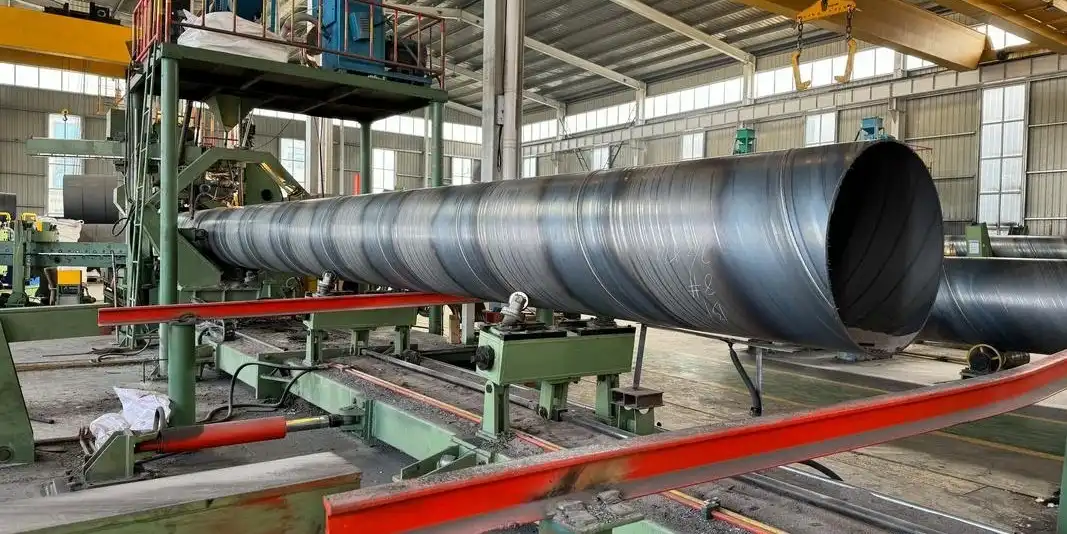
- Spiral forming at a set helix angle. Rollers bend the strip into a tube shape while feeding it forward at a fixed angle.
- Internal and external submerged arc welding. Both weld passes get laid under a flux layer that shields the arc from air contamination.
- Cutting, end finishing, and inspection. Pipes get cut to length, beveled if needed, and checked for diameter, thickness, and roundness before coating.
These five stages decide most of the final cost and strength outcome. A mill that rushes forming speed to cut cost often pays for it later in weld repair labor.
Process Variables That Affect Cost
Five things affect the price of every order: the width and availability of the strips and coils, the pipe's diameter and wall thickness, the speed at which the parts are formed, the scope of the inspection, the choice of coating, and the rate of scrap. People who only look at price per tonne often don't notice that a cheaper quote might skip steps that are important for inspecting pressure-rated pipelines.
How Steel Strip Quality Affects Pipe Strength and Durability
Steel Chemistry and Mechanical Properties
The starting strip controls how well the metal can be welded and how strong it is before it is formed. Mills give limits on sulfur/phosphorus, yield strength, tensile strength, elongation, and carbon equivalent because they show how the steel will react to arc heat. For example, hot cracking during welding is more likely when the metal has a lot of sulphur in it.
A Mill Test Certificate (MTC) should be included with every batch of strip used for SSAW carbon steel pipe. This certificate should list the chemical make-up and mechanical test results. EN 10204 says that buyers can ask for either a 3.1 or 3.2 inspection certificate, depending on how much independent checking the project needs.
Surface and Edge Condition
The welding process can go wrong because of rust, scale, laminations, and uneven strip width, which is hard to fix after the pipe is made. When the pipe is under pressure, a lamination inside the strip can become a weak spot. This is why entering checking counts as much as the welding step itself.
Here is what a strip quality check should cover before production starts:
- Visual inspection for rust, scale, and visible surface defects along the full coil length, since a single bad section can ruin an entire production run if missed early.
- Ultrasonic testing of strip, when the project specification calls for it, to catch internal laminations that visual checks cannot find.
- Dimensional checks on strip width and thickness tolerance, because variation here shows up as wall thickness variation in the finished pipe.
- Edge condition verification to confirm the milled edge is straight and free of cracks before spiral forming begins.
Strip Quality Decision Checklist
| Criterion | Why it matters | Evidence to request |
|---|---|---|
| Steel grade | Determines strength and weldability | MTC and heat number |
| Thickness tolerance | Controls final wall thickness | Coil inspection report |
| Surface condition | Reduces defects and coating problems | Visual inspection record |
| Edge quality | Supports stable spiral welding | Edge preparation record |
| Traceability | Links pipe to raw material | Heat and batch records |
Poor strip quality creates laminations, incomplete fusion, and dimensional defects that may not show up until the pipe is under load. The fix is simple: require approved material specs, incoming inspection, and full heat traceability on every order of SSAW carbon steel pipe you buy.
The Role of Spiral Welding in Structural Performance
Spiral Seam Geometry and Load Distribution
The helical weld angle changes how stress spreads across the pipe wall. A wider helix angle can speed up production but changes the weld length per unit of pipe. Pipe performance depends on the full design — grade, thickness, coating, and installation method — not the seam orientation alone.
Engineers reviewing a project should check internal pressure, external soil and traffic loads, bending during installation, and any cyclic loading from pumping operations. A piling pipe driven into dense soil faces different stress than a water transmission line buried in a trench.
SSAW Versus Other Pipe Manufacturing Methods
Clients often get confused choosing between SSAW and LSAW for a given pressure grade. The table below lays out the main differences:
| Feature | SSAW | LSAW | ERW | Pipe without a weld seam |
|---|---|---|---|---|
| Manufacturing route | Spiral submerged arc welded | Longitudinal submerged arc welded | Electric resistance welded | Pierced and rolled |
| Large-diameter suitability | Strong | Strong | More limited at larger sizes | Less economical at large diameters |
| Seam type | Helical | Longitudinal | Longitudinal | None |
| Typical cost position | Competitive for large diameters | Often higher for some sizes | Competitive in smaller sizes | Often highest |
| Main consideration | Spiral seam and forming control | Longitudinal seam quality | Frequency and weld control | Material and size limitations |
When Spiral Welding Is Appropriate
Large-diameter SSAW pipe can be used for dredging lines, municipal and industrial pipelines, piling and foundation systems and water transmission lines as long as the standard allows spiral construction and the pipe has good wear resistance. You can't just look at the width and thickness of the wall to figure out the pressure number; you also have to look at the grade, design code, quality of the weld, rust limit, and service temperature.
How Welding Parameters Influence Seam Strength and Quality
Critical Submerged Arc Welding Parameters
It depends on the current, voltage, movement speed, heat input, wire feed rate, flux state, and root gap alignment how well the weld on SSAW carbon steel pipe is done. If you only change one parameter and not the others, you could end up with incomplete fusion or porosity that can't be covered up with coating.
Common Weld Defects and Mitigation
The table below lists defects our quality team checks for most often during production runs, along with the usual root cause and fix:
| Potential defect | Likely cause | Typical mitigation |
|---|---|---|
| Lack of fusion | Low heat input or poor alignment | Adjust current, speed, and edge preparation |
| Porosity | Moisture, contamination, or unstable shielding | Control flux storage and cleaning |
| Undercut | Excessive current or travel speed | Optimize welding parameters |
| Slag inclusion | Poor bead cleaning or sequence | Improve interpass cleaning |
| Cracking | High restraint, chemistry, or hydrogen | Control material, preheat, and consumables |
Weld Qualification and Verification
Before accepting a shipment, make sure that the mill followed a qualified welding procedure specification and that the welders have up-to-date records of their qualifications. Ask for records of the welding procedure, calibration logs, and certificates for consumables. Before the pipe leaves the factory, make sure that it has passed all of the required tests, including visual, ultrasonic, radiographic, and hydrostatic tests.
Material Grades and Their Impact on Manufacturing Costs
Common Grade and Standard Categories
Almost everything else costs less than grade selection drives for SSAW carbon steel pipe. API 5L and ISO 3183 both talk about line pipe for moving oil, gas and pipelines. Pipe piles that are welded or not welded can use ASTM A252. As long as the right part is used, EN 10217 covers welded steel tubes for pressure reasons. Our mill in Youcheng sells API 5L Gr.B, X42, X52, X60, X65, and X70 steels, as well as Q235B and Q345B for building and pinning. All of these steels meet API 5L, SY/T 5037, and GB/T 9711 standards.
How Grade Selection Changes Price
It takes longer to work with and test higher strength grades because they need more careful welding and stricter control of the chemicals used. Extra steps are needed to test impact-tested grades for cold regions. If you need sour service or work offshore, it costs more to inspect and qualify, and lead times for premium grades can be longer.
Here is what to check before locking in a grade:
- Design pressure and operating temperature, since these two numbers set the minimum yield strength the pipe must meet under the applicable code.
- Impact toughness requirements, which matter most for projects in cold regions or where sudden pressure changes could cause brittle fracture.
- Corrosion and erosion environment, because a slurry line wears differently than a clean water transmission line and may need a thicker wall or harder coating.
- Documentation and inspection level the project specification demands, since this affects both price and delivery schedule.
CE marking is not automatic for every steel pipe. It applies when the pipe becomes part of a system covered by EU legislation such as the Pressure Equipment Directive. Confirm the legal route for your specific application before assuming CE is required.
How Wall Thickness Affects Strength and Production Expenses
Relationship Between Wall Thickness and Strength
Walls that are thicker can handle internal pressure, external compression, bowing, and damage from handling better than walls that are thinner. But strength relies on more than just width; it also depends on the steel type, the quality of the weld, and the amount of rust that can happen.
SSAW Carbon Steel Pipe Size and Weight Data
There should be a clear specification sheet for SSAW carbon steel pipe that lists the outside diameter tolerance, the wall thickness tolerance, the length type, the unit weight, the end type, the grade, the finish, and the test pressure. Our standard production range includes lengths from 6 m to 12 m, wall thicknesses from 5 mm to 25.4 mm, and outer diameters from 219 mm to 3620 mm. If you need a different size, just let us know.
A common formula for estimating uncoated pipe weight per meter is:
Weight per metre ≈ 0.02466 × t × (D − t)
Where D is outside diameter in millimeters and t is wall thickness in millimeters. Always confirm the density assumption and tolerance basis with your supplier before using this for commercial settlement.
Cost Trade-Off
Thicker walls use more steel and raise price per meter or ton. But going too thick also raises forming, welding, and transport costs without adding real benefit. The right answer is the lowest wall thickness that still meets the design pressure and service life target — not the thickest option available.
The Impact of Forming Technology on Dimensional Accuracy
Spiral Forming Controls
Accurate measurements depend on the forming angle, roll alignment, coil tension, and seam tracking while the product is being made. If the rollers in a mill are worn out or the feed tension isn't stable, the pipe it makes isn't always round, which makes installation in the field difficult.
Dimensional Requirements to Verify
Before receiving a package, buyers of SSAW carbon steel pipe should check the outside diameter tolerance, wall thickness tolerance, straightness, ovality, bevel angle, and weld reinforcement height. When pipes need to be joined tightly in the field, these numbers are the most important.
Why Accuracy Affects Total Cost
With more accurate measurements, field fit-up time is cut down and installation doesn't get held up. When ends aren't shaped correctly, they cost more to join and connect on-site. Too much difference can cause pipes to be rejected or claims to be made after the goods have already arrived at the project site, which is a cost that no one wants to pay in the middle of a project.
Non-Destructive Testing and Its Effect on Quality Costs
Typical Inspection and Testing Sequence
SSAW carbon steel pipe quality control always goes in this order: review of the raw materials, visual and dimensional inspection, weld seam inspection, ultrasonic or radiographic testing, hydrostatic testing, mechanical verification, coating inspection, and finally marking and packing.
NDT Methods and Appropriate Uses
The table below summarizes the main testing methods and what each one actually catches:
| Method | Main purpose | Typical limitation |
|---|---|---|
| UT | Detects internal and planar weld defects | Requires calibration and qualified operators |
| RT | Provides radiographic evidence of volumetric defects | Higher cost and safety controls |
| MT | Finds surface and near-surface defects in ferromagnetic steel | Not suitable for all defect orientations |
| PT | Detects surface-breaking defects | Requires suitable surface preparation |
| Visual inspection | Identifies visible weld and dimensional issues | Cannot confirm internal integrity |
Inspection Cost Versus Failure Risk
Basic inspection lowers the upfront price but gives less proof of weld integrity for critical service. Full-length weld NDT raises cost but gives better documentation and defect detection. Third-party inspection adds another cost layer but builds buyer confidence — and most overseas clients on large tonnage orders now request it as standard practice.
Case in point: Youcheng sent 850 tonnes of X52 SSAW carbon steel pipe with a diameter of 1200 mm and a wall thickness of 10 mm to the southern Philippines for a project to move water between cities. Everyone who owned the project had to have an outside ultrasonic inspection of every weld seam. In about 1,200 separate UT scans, there were no weld rejections, and the FBE-coated pipe passed the hydrostatic test at 1.5 times the design pressure on the first try. The actual time it took from production to shipping was 42 days, while the original estimate was 55. This was partly because the mill had enough coil stock to avoid a delay in getting raw materials. The schedule stayed on track thanks to that inventory buffer as well as good welding skills.

How Production Efficiency Influences SSAW Pipe Pricing
Main Cost Drivers Behind SSAW Carbon Steel Pipe Price
The price per tonne changes based on the yield and cost of the steel sheet, the width and wall thickness of the steel, the production output, the welding supplies, the level of NDT, the choice of finish, and the terms of the freight. Currency changes and different payment terms can also change the final landed cost, especially for orders of a lot of tonnes that are paid for in stages.
Procurement Factors to Compare
Before comparing two quotes side by side, get answers to these questions from each supplier:
- MOQ and lead time, including whether the quoted lead time covers production, testing, coating, and packing, or just the raw forming stage.
- Price basis, since a quote per ton reads very differently than a quote per meter once wall thickness changes.
- Payment and Incoterms, covering advance payment share, letter of credit terms, and whether the price is EXW, FOB, CFR, CIF, or DAP.
- Documentation package, including MTC, inspection plan, test reports, certificate of origin, and packing list — missing documents can delay customs clearance by weeks.
Supplier Capability and Evaluation
You can't just look at price; you also need to look at the range of products they make, their experience exporting, the ability to track certificates, their welding and NDT skills, their access to an in-house lab, and their finishing support. Our Tianjin facility at Youcheng has about 20,000 tonnes of steel products in stock. For repeat orders, the lead time is 7–10 days, and buyers can get answers to their questions 24 hours a day. These are the kinds of details that matter a lot when a project manager is rushing to meet a construction deadline.
A 2025 industry review from the China Industry Research Institute says that the need for large-diameter spiral-welded pipe in water infrastructure and energy gathering projects has kept growing as oilfield and municipal operators replace old networks. This has forced mills to keep bigger stocks of raw materials to meet shorter delivery windows.
Balancing Manufacturing Costs with Long-Term Pipe Performance
Lifecycle Cost Versus Purchase Price
The total cost of SSAW carbon steel pipe includes the pipe material, the coating system, the transport and storage, the welding in the field, the inspections, the repairs, and finally the replacement. A less expensive pipe with a weak coating that is used in a slurry environment usually costs more over ten years than a slightly more expensive pipe that has good corrosion protection.
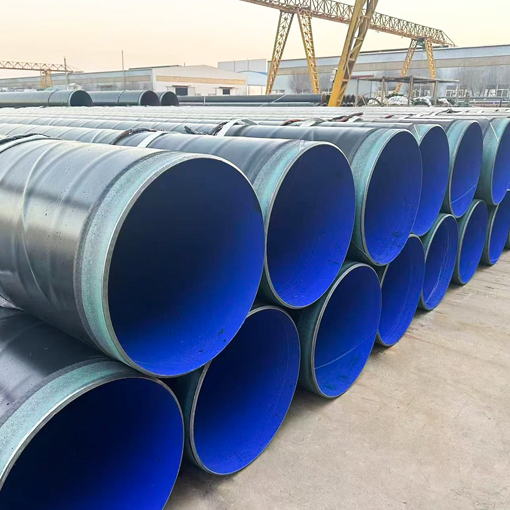
Which covering to use depends on three things: where the pipe is placed, what runs through it, and the standard that is being used. Three-layer polyethylene, or 3PE, has an epoxy base that is fused together, a sticky middle layer, and a polyethylene jacket. It is the standard material for underground oil and gas lines that will be in touch with dirt for years. FBE is suitable for gas service work that meets API 5L PSL2. It must be tested for cathodic disbondment and adhesion before it is shipped. It is used inside pipes that carry drinking water, where it is important for both flow efficiency and long-term surface safety. Bitumen 3-coat 2-cloth is used for sewage and irrigation lines because wet, chemically active earth wears down less durable coats over time. All of these are made at our Tianjin facility to meet GB/T 23257 coating standards.
Use-Case Scenarios
Three buyer types approach SSAW pipe selection differently, and each one should weigh cost and performance in its own way:
- Large municipal and oilfield EPC contractors need stable supply, API/CE documentation, and third-party inspection on every batch. Their main risk is a weld failure discovered after burial, so full NDT coverage and hydrostatic test records matter more than shaving a few dollars off price per ton.
- Mid-sized civil, piling, and dredging contractors run tighter budgets and care most about delivery schedule and anti-corrosion options that fit slurry or wet soil conditions. For these buyers, confirming coating type and lead time upfront avoids costly schedule slips mid-project.
- Local traders and small sub-contractors want flexible batch sizes, fast turnaround, and simple certification. A supplier with existing stock, like our roughly 20,000-ton inventory, can serve this group without forcing a full production run for small orders.
Final SSAW Selection Checklist
Before placing an order for SSAW carbon steel pipe, make sure you know the application and design loads, choose the right standard and grade, set tolerances for diameter and wall thickness, confirm the weld and NDT requirements, choose the coating, and ask for full MTC and traceability documents. Look at the total cost, not just the price per tonne, and get approval from an engineer before switching from SSAW pipe to LSAW, ERW, or non-welded pipe on a line that needs to withstand high pressure.
Risks, Pitfalls, and Mitigation
| Risk | Potential consequence | Mitigation |
|---|---|---|
| Treating all SSAW pipe as equivalent | Wrong product selection | Compare grade, standard, tests, and tolerances |
| Choosing by price per ton only | Higher installation or failure cost | Use lifecycle cost analysis |
| Incomplete documentation | Customs, acceptance, or traceability problems | Define document requirements in the purchase order |
| Unverified pressure capability | Leakage or failure | Use approved design calculations and code compliance |
| Poor coating or storage | Premature corrosion | Specify coating system and handling controls |
Conclusion
How much a pipe costs and how strong it is depend on the same set of choices: the quality of the steel strip, how accurately it is formed, how well it is welded, how thick the wall is, and how deep the test is. Large-diameter projects can save money on SSAW carbon steel pipe without sacrificing strength, as long as the mill handles the whole process, from coiling to finishing. The two biggest mistakes people make in this market are choosing based only on price per tonne and thinking that all spiral welded pipe is the same. If buyers ask the right questions about grade, paperwork, and inspection scope, they can avoid these problems.
FAQ
How do you spell SSAW carbon steel pipe?
With submerged arc welding, the spirally formed steel strip is joined to the pipe to make SSAW carbon steel pipe. It is often used for large-diameter water pipelines, piling, mining, structural, and industrial pipes.
How does the process of making SSAW pipes change their strength?
Grade of steel, quality of strip, accuracy of making, weld penetration, heat control, wall thickness, and checking all affect how strong something is. Consistency and dependability are improved by a controlled process that uses qualified welding techniques and the right NDT.
Does SSAW pipe cost less than LSAW pipe?
For large diameters, SSAW pipe can be priced similarly to other types because it uses a continuous steel strip and flexible shaping. The final cost is based on the type of steel, the thickness of the walls, testing, coating, the number of items ordered, and the delivery terms.
What is the difference between SSAW and ERW carbon steel pipe?
SSAW is a spiral submerged arc weld that is often used for bigger diameters. Electric resistance welding, or ERW, is often used for smaller or medium-sized holes or for jobs that meet certain ERW standards.
How do you figure out how much SSAW carbon steel pipe weighs per metre?
There is a typical guess of 0.02466 × t × (D - t), where D is the outside width in millimetres and t is the wall thickness in millimetres. The density, tolerances, and method of calculation should all be spelt out in the purchase specification.
What rules apply to SSAW carbon steel pipe?
Depending on the use, API 5L, ISO 3183, ASTM A252, ASTM A53, and EN 10217 are some standards that could be used. The buyer has to make sure that the standard they chose allows for the product form and service condition they need.
Is it possible to send water through SSAW pipe?
Yes, SSAW pipe is commonly used to move water as long as the grade, wall thickness, weld quality, and covering meet the pressure design and infrastructure needs. For each project, the internal lining and water-contact compliance should be looked at separately.
Get a Quotation Matched to Your Project Specification
It shouldn't take weeks of emailing back and forth to figure out the best way to make something. Youcheng sells SSAW carbon steel pipe directly from our Tianjin factory. We have around 20,000 tonnes of stock and a standard lead time of 7–10 days for repeat orders. Our pipes are certified by API 5L, SY/T 5037, and GB/T 9711. Send your diameter, grade, and finishing needs to sales@youchengkjsteel.com, and we'll get back to you within 24 hours with a specification sheet and quote for SSAW carbon steel pipes, whether you need a big mass bid or a smaller, more flexible batch.
References
1. ISO 3183:2019, Petroleum and natural gas industries — Steel pipe for pipeline transportation systems, International Organization for Standardization. Cited for line pipe standard requirements. https://www.iso.org/standard/75476.html
2. EN 10204, Metallic Products — Types of Inspection Documents, European Committee for Standardization, 2004. Cited for mill certificate classification. https://www.cencenelec.eu/
3. China Industry Research Institute, Steel Pipe Industry Market Analysis Report, 2025. Cited for large-diameter spiral welded pipe demand trends. https://www.chinairn.com/hyzx/20250519/173955592.shtml
About the author: Stella Yang is Sales Manager at Tianjin Youcheng Technology, where she works directly with municipal EPC contractors, oilfield project teams, and civil contractors across the Middle East, Southeast Asia, and South America on SSAW carbon steel pipe orders. She has over eight years of experience matching project specifications to production capability, covering steel grade selection, coating systems, and export documentation for large tonnage and small batch orders alike.
you may like
.webp)

.webp)